How to Save Items From Different Stores in One Place
Carts expire, tabs vanish and every store keeps its own list. Build one store-independent list that holds the link, the variant and the reason you saved it, and watch only the items where a change would change your mind.
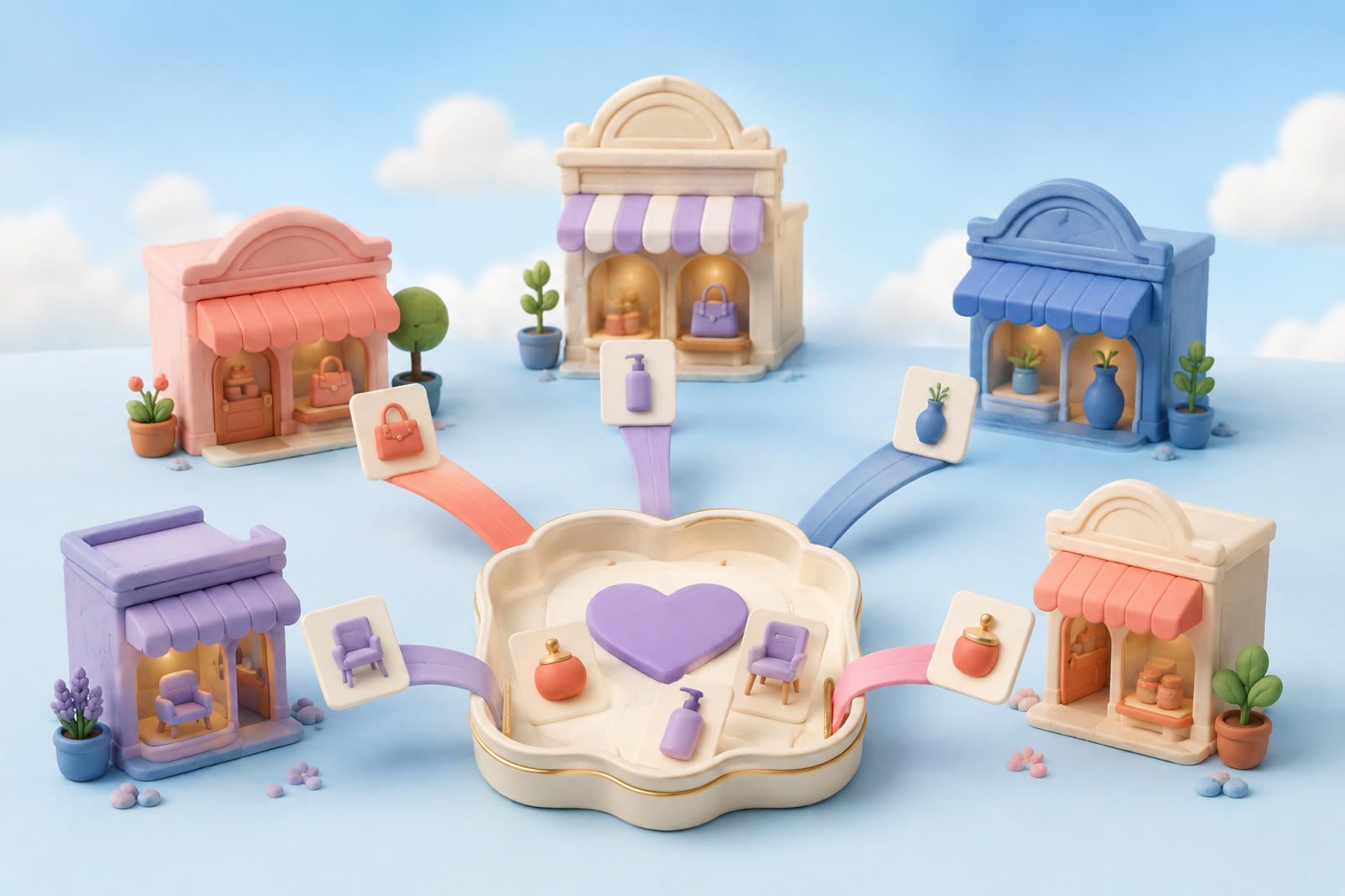
Shopping across five stores creates five small memory problems. One item sits in an Amazon list, another is stranded in a local shop's cart, two live in open tabs, and the last survives only in a message you sent yourself. None of those places provides a complete view of what you are considering.
A cart is especially unreliable as a long-term list. It is designed to move you toward checkout, not to preserve research. Items can disappear, sessions expire, regional storefronts change, and a cart rarely records why you chose one version over another.
The practical solution is a universal shopping list: one layer above individual stores. dEssence can serve as that layer through its Chrome extension, Telegram bot, or web app. It keeps the source link attached to the saved item, so the final purchase still happens at the retailer.
Build one list above all your shopping sites
The simplest system has three parts:
- One capture destination. Every product goes to the same place, regardless of store.
- A useful recognition note. Record the detail future-you will care about: “linen, not polyester,” “fits the 42 cm shelf,” or “gift idea for Sam.”
- A separate decision to monitor it. Saving is not the same as watching. In dEssence, you set up price or stock watching on a saved item yourself.
That distinction matters. A broad list can contain casual ideas, comparisons, gifts, and replacements. Your watched list should stay smaller and contain items where a change in price or availability would affect your decision.
How to save products from different stores, step by step
Do the setup once, then make capture deliberately boring. If saving requires reorganizing a database every time, you will return to tabs and carts within a week.
What information should the master list keep?
At minimum, preserve the product name, retailer, source URL, and your own note. For items with meaningful variants, include size, color, model number, dimensions, or pack quantity. A price without a variant can be misleading: the attractive number may belong to the smallest size or a different finish.
Do not force every item into a complex category tree. A few plain groupings—home, clothing, gifts, replacements—are enough for most people. Searchable phrases often work better than precise filing because you are more likely to remember “quiet fan for bedroom” than the folder chosen six months ago.
Carts, bookmarks, spreadsheets, or a universal list?
Carts are good for checkout sessions. Browser bookmarks preserve links but provide a poor shopping overview. Spreadsheets are strong for deliberate comparisons, especially when you need formulas and many specifications, but slow for everyday capture.
A store-independent saved list is the balanced choice when you need quick capture and later recall across retailers.
Keep the list useful after the first week
Review it when you are ready to shop, not on an arbitrary daily schedule. Remove items you bought, rejected, or no longer understand. If two listings represent the same product, keep both only when the retailer difference is useful—perhaps one has better returns while another has a lower delivered price.
For dEssence, the Free plan is $0 forever, needs no card, allows up to 20 saves a day, and lets you watch 100 things with daily checks. Pro is $10 a month, supports a higher daily save limit, watches 100 things with hourly checks. Start with the free plan unless the number or urgency of watched purchases genuinely requires more.
The payoff is not merely tidiness. A single list slows accidental checkout, makes alternatives visible, and gives you a reliable answer to “Where did I see that?”