Once You Google It, You Stop Trying to Remember
When you know you can look something up, memory hands the job over and keeps the address instead of the answer. The research behind that, and what it means for how you save things.
You look something up, you get the answer, and a week later the only thing left is a vague sense of where you found it — a tab, a newsletter, something with a dark header. That is not carelessness. It is a pattern that has been measured, and knowing its shape tells you exactly which half of your setup to fix.
What the study actually found
The paper is Google effects on memory: cognitive consequences of having information at our fingertips, by Betsy Sparrow, Jenny Liu and Daniel M. Wegner, published in Science in 2011 and indexed on PubMed.
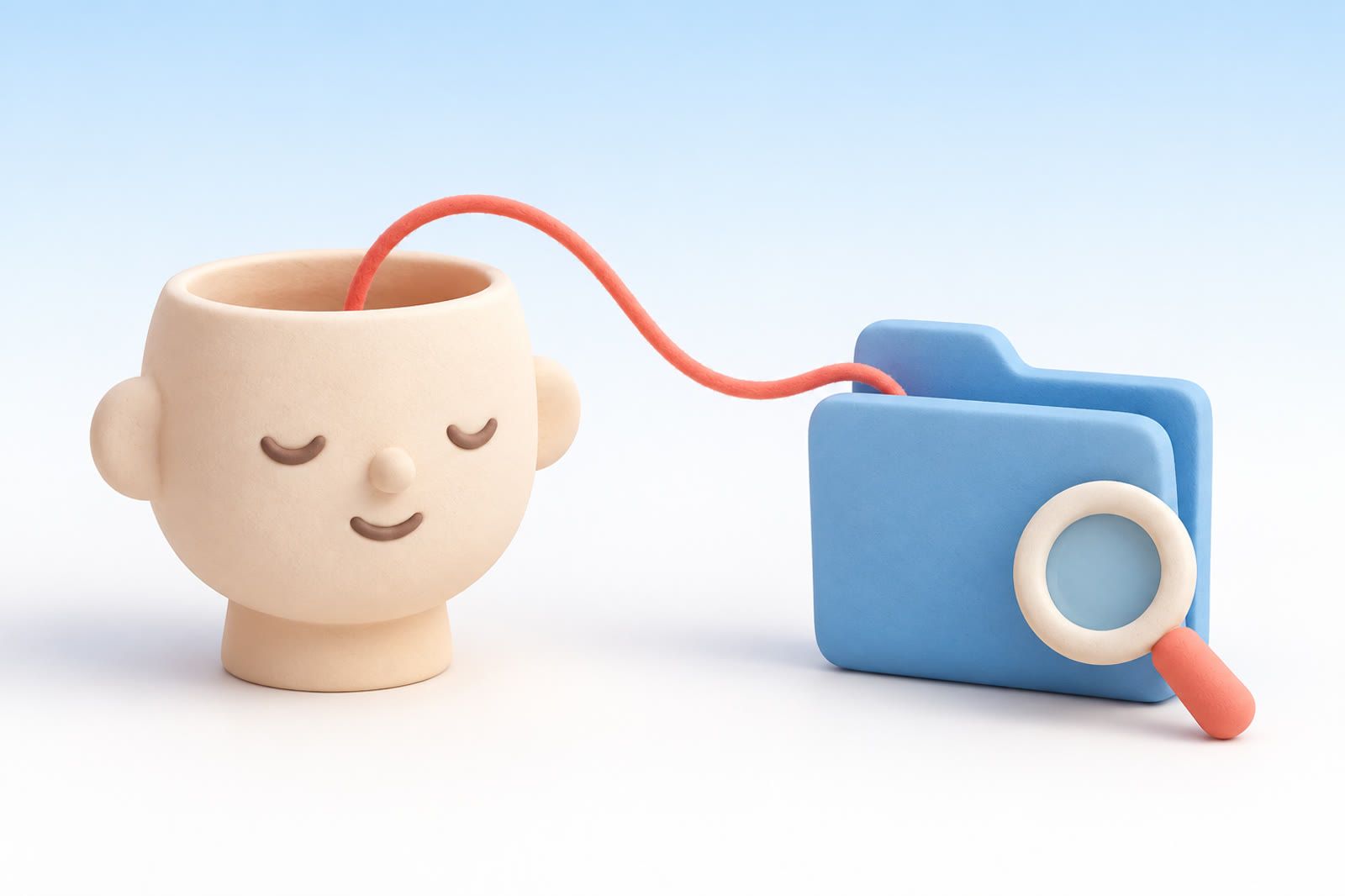
Across four experiments, the researchers looked at what people do with information when a computer is in the room. When participants typed statements into a computer and were told the material would be saved, they recalled those statements less well than participants who were told the material would be erased. And when statements were filed into named folders, people were better at remembering which folder a statement went into than at remembering the statement itself.
That is the whole claim, and it is worth keeping it that narrow. The study does not say search engines damage memory. It does not measure anyone's intelligence, and it says nothing about brains getting worse. It describes a shift in what memory spends its effort on: less on content that will still be sitting there, more on the route back to it.
This is old behaviour with a new surface
Wegner had spent years before that paper on transactive memory — the ordinary business of remembering things through other people. One person in a couple keeps the birthdays, the other keeps where the tax paperwork lives, and neither feels diminished by the arrangement. Address books, recipe boxes and the phone numbers you stopped memorising the year you got a mobile are all the same deal with a different partner.
Offloading is not the problem. Offloading onto something unreliable is. A transactive partner who forgets is worse than no partner at all, because you already stopped keeping your own copy. That is precisely the position a bad save system puts you in, and it is why the sinking feeling of "I know I saved this somewhere" is so specific.
Where the external half falls over
<img src="https://ewr1.vultrobjects.com/dessence-cms-prod/google_first_stops_recall_folder_39338207a3.png" alt="Clay folder with a curled corner and a thread trailing from inside" style="width:100%;height:auto;display:block;">Four failures, in rough order of how often they happen.
Saved and unfindable. The thing is in the system. You just cannot produce the exact title, and the search box wants the exact title. Your memory kept the gist, the tool kept the string, and they never meet.
A folder with no reason in it. You bookmarked forty articles under Read later. Not one of them records why it looked worth reading, so opening the folder is a fresh triage job rather than a pickup.
A screenshot with no context. A price, a room, a quote, sitting in a camera roll between a parking sign and a child's drawing. You will scroll past it eleven times before the day you need it.
Two hundred tabs. Tabs are a memory system with no index and a hard limit: the moment there are enough of them to be worth searching, each one is four pixels wide.
A five-minute test of your own setup
Try this before changing anything. Write down five things you know you saved in the last month — an article, a product, a recipe, an address, a video. Describe each in the words you would use with a friend, not the title. Then give yourself two minutes per item to actually retrieve it.
What the score tells you is which half is broken. If you can name all five, your memory for where is doing its job and your retrieval is the weak link. If you cannot even name five, the problem is upstream: you are saving things with so little attention that no location memory forms at all, and a longer archive will not help.
What makes an external memory worth trusting
The research explains why location memory carries so much weight. It follows that the useful work is not saving more. It is making the place you save into strong enough to deserve the trust you have already given it. Three properties do most of that work.
Where the tools stand
Most save tools are built for the moment of saving, which is the half that was never hard. The half that pays off is the return trip, months later, with none of the context you had at the time.
That is the gap dEssence is built around. You save with the Chrome extension, the Telegram bot or the web app, and you ask for things back in your own words rather than by exact title. If a saved thing has a price, a stock level or a date attached that matters to you, you set a watch on it yourself — a second, deliberate action, because most of what anyone saves does not deserve to be checked. The free plan is $0 with 20 saves a day and up to 100 watches checked daily; Pro is $10 a month, with 150 saves a day and those watches checked hourly.
Googling it again is not the failure. The failure is having nowhere good to put the answer once you have it.