A personal knowledge tool that needs zero maintenance
Linking, tagging, and gardening are the chores that turn knowledge tools into a second job. Here is what a maintenance-free personal knowledge tool does instead, and what it honestly gives up.
A personal knowledge tool that needs zero maintenance is one where the only action is saving. There is no graph to tend, no tags to apply, no notes to relink or review on a schedule. You keep things as they come, and later you find them by asking in your own words. The upkeep is gone.
If you have used a serious knowledge tool, you know the arc. The setup is the fun part. You build the structure, learn the linking syntax, design a tag scheme, watch the graph grow. Then the bill arrives. Every new note wants a place, a label, a connection to the right other notes. Skip a week and there is a backlog. Skip a month and the system feels broken, because the careful order you built is now out of date. The 2026 writing on this is blunt about it: these tools reward consistency and punish neglect, and most people cannot sustain the consistency.
The point of a maintenance-free tool is not that organizing is bad. It is that the upkeep is the thing people quit over, not the saving. Remove the upkeep and the habit survives. This piece covers what "zero maintenance" actually means, why graph-tending and tagging fail in practice, what replaces them, and where this approach genuinely gives something up.
What does zero maintenance actually mean?
It helps to be precise, because "low effort" gets claimed a lot. A genuinely maintenance-free tool removes four recurring jobs that other systems quietly assume you will do forever.
The first is filing at save time. In most tools, the moment you keep something you also have to decide where it goes and what to call it. A maintenance-free tool drops that decision. You save, and that is the whole interaction.
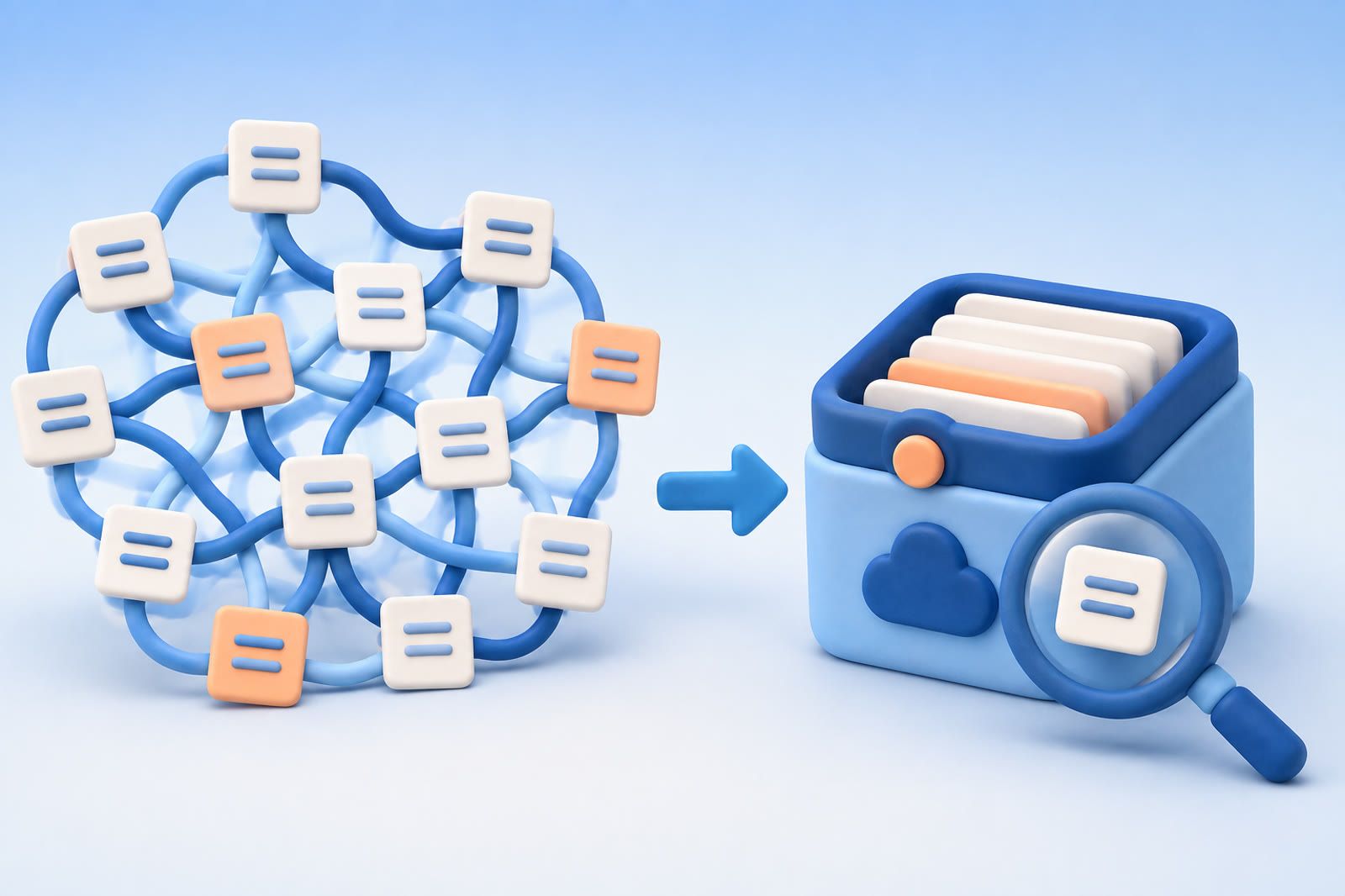
The second is linking. Graph-based tools ask you to connect each note to related notes by hand, so the network stays useful. That is real, ongoing work, and it decays the instant you fall behind. A maintenance-free tool computes relationships from meaning when you ask, instead of asking you to wire them in advance.
The third is tagging and re-tagging. A tag scheme that fit your life last year rarely fits this year. Old categories decay, new ones pile up, and the navigation layer becomes its own problem to manage. A maintenance-free tool has no tag scheme to drift out of date.
The fourth is the review ritual. Many methods prescribe a weekly or monthly pass to clean up, reconnect, and prune. It is the step almost everyone drops first. A maintenance-free tool does not depend on a review you will not keep, because retrieval does not rely on the archive being tidy.
What is left when those four jobs are gone is a single verb: save. Save it, forget it, ask for it later. That is the test of whether a tool is actually maintenance-free, not whether the marketing says "effort-free," but whether there is any recurring job at all between saving and finding.
Why does graph-tending and tagging fail in practice?
The failure is not about discipline. It is about timing. Every upkeep task asks you to pay a cost now for a benefit that is uncertain and far away.
When you tag a note or draw a link today, you feel nothing useful back. The payoff, if it comes at all, is months out, and by then you might not remember the tag scheme anyway. Humans are reliably bad at paying steady costs now for vague rewards later. That is not a character defect. It is how habits form and break, and any system that ignores it ends up fighting its own users.
There is a second trap on top of the timing problem: the work feels productive while you are doing it. Building the perfect structure, refining tags, grooming the graph, all of it gives the satisfying sense of progress without the actual progress. People get so caught up making the system perfect that they forget to use it. The upkeep stops being a means to recall and becomes a hobby that competes with the work it was supposed to support.
And the cost compounds. Each capture is a small organizational decision, which folder, which tag, which project. One decision is nothing. Hundreds of them, every week, drain the same attention you need for decisions that matter. By the time the backlog feels heavy, the rational move is to stop, and most people do.
What replaces the graph and the tags?
The replacement is retrieval by meaning, often called semantic search. Instead of matching the exact words in a note, it represents your question and your saved content as meaning and returns what is closest in idea. As this matured through 2026, it stopped being exotic and became the expected way to find things.
The practical effect is that you can find something even when you do not remember how you saved it. You kept an article months ago and now you only recall the gist. You ask "that piece about pricing for early products" and it comes back, because the meanings line up even though your words do not match the original. Once finding works this way, the reason for the graph and the tags disappears. You built them to find. If you can find by asking, you do not need to build them.
This is the design behind dEssence. You save through the web app, the Chrome extension, or the Telegram bot, with no folder to pick and no tag to invent, and the connections are computed from meaning when you ask rather than maintained by you in advance. No folders, no tags, no organizing. The structure still exists, it is just not your job to keep it current.
How does a maintenance-free tool work day to day?
The day changes shape once upkeep is gone. You stop being the librarian and become someone who keeps things and asks for them.
You read something worth keeping, so you save it. A screenshot worth keeping, save it. A PDF a colleague sent, a voice memo on a walk, a link from a chat, save, save, save. There is no place to decide and no label to write. The cost of keeping something drops to roughly nothing, which is the only condition under which people actually keep things week after week.
Later, you ask. "What was the research on bookmark retrieval?" "The contract clause I flagged last month." "The thing my colleague sent about the database change." You ask in your own words, the way you would ask a person who was there, and the relevant material comes back. You never had to predict in advance that you would need it, or where to put it so you could find it. That is the difference between memory you have to maintain and memory you don't have to maintain. One asks for upkeep forever. The other just remembers.
Does removing maintenance mean losing structure?
No. It means the structure is computed, not hand-built. The relationships are still there, an article connects to a decision connects to a conversation, but you do not encode those links yourself. They surface when you ask, drawn from meaning rather than maintained by you on a schedule.
There is an honest exception. A small number of people genuinely enjoy the gardening. For them, building the graph and refining tags is not a tax, it is the point, and a maintenance-free tool can feel like it removed a hobby. That is a fair complaint. The approach here is aimed at the larger group who tried the upkeep, fell behind, and quit, and who would rather spend the time recalling than grooming.
Honest about dEssence
The trade-offs are worth naming plainly. dEssence is in beta, so the paid tier is not finalized and behavior is still changing, which matters if you want a settled tool to build a years-long system on. There is no native iOS or Android app yet: you capture through the Chrome extension, the Telegram bot, or the web app at dessence.ai, a narrower set of entry points than some mature, fully native tools offer. It is also not a team workspace, so shared docs, permissions, and collaborative editing are not what it is for. And because retrieval gets better as you save more, a brand-new account will feel thin for the first week or two. Zero maintenance does not mean zero habit: the saving reflex still has to be there before the asking feels worth it.
Frequently asked questions
Is there a PKM tool that doesn't require maintenance?
Yes, in the sense that the recurring upkeep is removed. A maintenance-free personal knowledge tool drops filing, manual linking, tagging, and the cleanup review. You save things as they come and find them later by asking in plain words, and the relationships are computed from meaning rather than wired in by you. There is no graph to tend and no tag scheme to keep current, so the jobs that usually pile into a backlog never exist.
Why do people abandon knowledge tools like Notion, Obsidian, and Roam?
The most common reason is upkeep. These tools reward consistency and punish neglect, so skipping a week creates a backlog and skipping a month makes the system feel broken. Each capture also forces an organizational decision, and those small decisions add up to real fatigue. People rarely quit because they stopped caring. They quit because the work of keeping the system running grew heavier than the benefit.
What does a maintenance-free tool give up compared to a graph tool?
Fine-grained manual control. If you want to hand-shape exactly how ideas connect, draw your own links, and design a bespoke structure, a maintenance-free tool will feel hands-off, because it computes connections from meaning instead of letting you author them. You trade authored structure for the lack of upkeep. For people who quit graph tools over the upkeep, that is a good trade. For people who love the gardening, it may not be.
Will I lose things if I never organize them?
Not if retrieval works. The fear of losing things comes from older systems where the only way back in was the filing you stopped keeping up. When you can ask for anything in your own words, the lack of folders and tags does not mean the lack of recall. The order is computed from meaning at the moment you ask, rather than maintained by you ahead of time.
A personal knowledge tool that needs zero maintenance is not about caring less. It is about spending attention on recall instead of on upkeep you will not sustain. If the maintenance is what keeps killing your systems, a tool built to skip it is worth a try. dEssence is free during beta with no card required, and the beta, capture, and not-a-team-workspace trade-offs above are worth weighing against how much you would rather ask than tend.