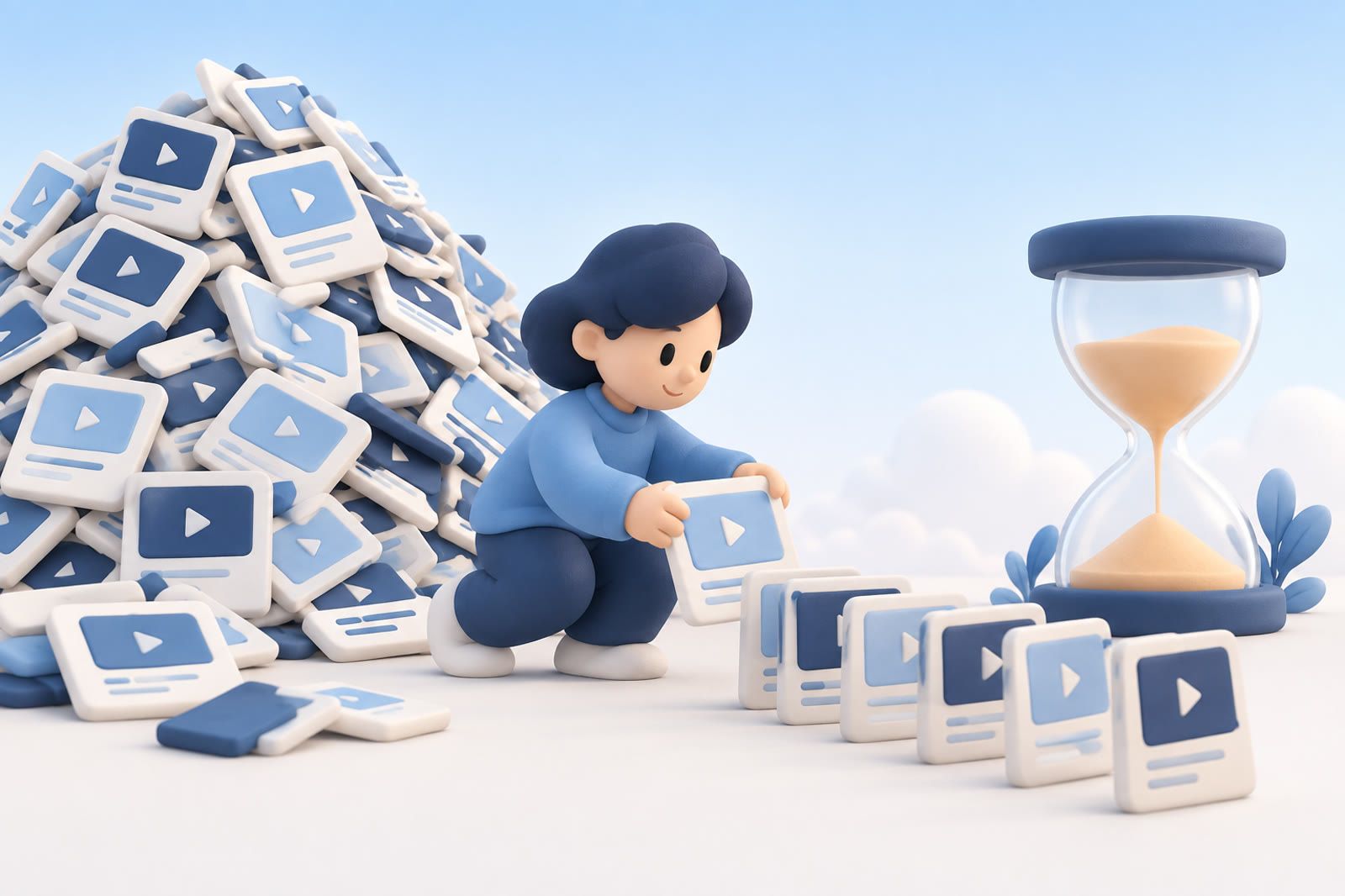
If Your Saves Never Get Done, You Are in Good Company
Later never comes for most of what you save. Research says one in five adults is a chronic procrastinator. Here is why, and the fix.

If Your Saves Never Get Done, You Are in Good Company
One person on Reddit described the whole cycle in two lines: "Save something on YouTube. Bookmark an article. Star a tweet. Tell myself I'll organize it later. Later never comes." If you read that and felt a small jolt of recognition, you already know the shape of this. The saving is easy. The list grows. And the moment you promised yourself, the one where you finally sit down and get through it, just never arrives.
It is tempting to read that as a personal failing. You are clearly disorganized, you tell yourself, or lazy, or bad at follow-through. But the pattern is far too common to be a private defect. Almost everyone with a phone has a read-later pile they have not touched in months, a tab open for three weeks, a camera roll thick with screenshots they meant to act on. The thing that wears people down is not the saving. It is the quiet, growing pile of later that never becomes now.
There is research that explains why later keeps slipping, and it is worth knowing, because once you see the mechanism, the fix stops being about willpower and starts being about how your saved things are built to come back to you.
One in five of us is wired to put things off
This is not a niche struggle. A 2007 study of chronic procrastination, published in the Journal of Cross-Cultural Psychology, found that roughly twenty percent of adults self-identify as chronic procrastinators. That figure was not a fluke of one sample. It held up across the United Kingdom, the United States, Australia, Spain, Peru, and Venezuela, in samples of well over a thousand adults each. One in five people, across very different cultures, are reliably the kind who mean to do the thing and then do not.
That reframes the guilt. Putting off your saved articles is not a quirk of your particular brain. It is a stable, population-level pattern that shows up wherever researchers go looking. If your saves never get done, you are not the exception. You are in the company of a fifth of the planet.
And that twenty percent is the people who will openly call themselves procrastinators. The behavior itself, meaning to get to something and then not, reaches far wider than that. Nearly everyone does it with some category of saved thing. The chronic group just lives there full time.
Why "later" almost never becomes now
Knowing it is common does not explain why it happens. A separate meta-analysis of procrastination, drawing on 691 correlations, named the strongest and most consistent drivers: task aversiveness, low confidence that the effort will pay off, and impulsiveness. In plain terms, we put off the things that feel like a chore, the things we are not sure are worth it, and we get pulled toward whatever is easy and immediate instead.
Now look at what a read-later pile actually asks of you. Getting through a saved article is mildly aversive. It is work, and you saved it precisely because you did not have the energy in the moment. You are also not sure, on any given day, that this particular item is the one worth opening, because it sits in a heap of hundreds that all look equally optional. And there is always something more immediate one swipe away. Every single factor that drives procrastination is stacked against the saved pile.
The design of most saving tools makes it worse. They are wonderful at the easy half, capturing, and indifferent to the hard half, returning. Saving takes one frictionless tap. Coming back takes intention, memory, and a scroll through a wall of forgotten items. So the saving multiplies and the doing stalls, which is exactly the gap the research predicts.
The pile is mentally expensive before you ever open it
Here is the part that quietly drains you. Each saved thing carries a small open loop, a note to self that reads "I should deal with this later." One person on Reddit put it well: "Every saved link feels harmless in the moment, but over time it turns into a growing pile of 'I should engage with this later.' That pile is mentally expensive even before you read a single thing."
That is the real cost of later never coming. It is not just the lost articles. It is that an unread, unsorted pile sits in the back of your mind as a standing debt. The longer it grows, the more it weighs, until some people declare what one Reddit user called a "bankruptcy" and wipe the whole thing, dumping years of saved things in one defeated click. Others let it grow and carry the low hum of guilt.
Both responses miss the actual problem. The pile is not heavy because you saved too much. It is heavy because nothing in it ever comes back to you on its own. You are the only retrieval mechanism, and a procrastinating brain is a poor one. So the loops stay open, and they stay open precisely because closing each one requires the kind of deliberate effort the research says you will tend to avoid.
Make saved things come back on their own
If the problem is that later never comes, the answer is not to discipline yourself into a different brain. It is to stop relying on a future you that the evidence says is unlikely to show up. The keeping should pay off without requiring a heroic act of follow-through.
That is the idea behind dEssence, an AI personal memory app built on a simple principle: save anything from anywhere in one motion, then find it later just by asking. You send a link, a screenshot, a voice note, or a PDF through Telegram, your browser, or the web app, and that is the whole job. There are no folders to choose, no tags to maintain, no weekly cleanup to procrastinate on. The aversive, effortful half of the system simply is not there.
The difference shows up when a topic comes back around. Instead of needing to remember the pile exists and scroll through hundreds of identical items, you describe what you are after in plain language, "that piece on sleep," "the cafe someone recommended," and it surfaces. dEssence also brings related things you saved back to you when they become relevant, so a saved item is not waiting on your discipline to resurface. And because it works across the assistants you already use, ChatGPT, Claude, and Gemini, it sits as a layer over your scattered saving rather than becoming one more app to abandon. Later does not have to come, because the thing comes to you.
What changes when saving finally pays off
The quiet shift is this. When what you saved actually returns at the moment it is useful, the open loops close themselves. You are no longer carrying a debt of unread items, because you are not the one responsible for dragging each one back into view. The pile stops being a standing reminder of what you have not done.
That takes the procrastination out of the equation, not by fixing your willpower, but by removing the task it kept stalling on. There is no longer a daunting backlog to face down on a free Saturday, because retrieval happens by asking, one item at a time, exactly when you need it. You stop re-saving the same things defensively, because the first save is findable. You stop declaring bankruptcy, because there is nothing to declare bankruptcy on.
Being a chronic procrastinator about your saved stuff is normal. One in five of us is built that way, and nearly everyone does it sometimes. The trick is not to become someone else. It is to save in a way where later coming was never the requirement.
FAQ
Is it normal that I never get to the things I save?
Yes. A cross-cultural study found that about twenty percent of adults are chronic procrastinators, and the meaning-to-do-it-later pattern is even more common than that. Putting off your saved articles is a population-level behavior, not a personal failing.
Why do I keep saving when I know I will not get to it?
Saving is frictionless and immediate, while returning to a saved item is mildly aversive and uncertain, the exact conditions research links to procrastination. The capture half is easy, so it multiplies; the doing half is hard, so it stalls.
How does dEssence help if I am the type who never follows through?
It removes the follow-through requirement. You save in one motion with no sorting, then find things by asking in plain language, and relevant saves resurface on their own. The keeping pays off without depending on a disciplined future self.